A reframe of AI as collective human output, and what it changes about the work designers do.

I'm a humanist technologist and designer. I've been writing this article with an AI. The AI is, in some meaningful sense, made from work like mine. Twenty years of design decisions are probably in a training set somewhere. Component libraries I built. Specs I documented carefully and watched get archived when projects ended. A working model needs more human output than most people pause to consider. What I find genuinely interesting is the strangeness. I'm asking it to help me understand what it's made of. That's either beautiful or deeply weird. I've landed on both.
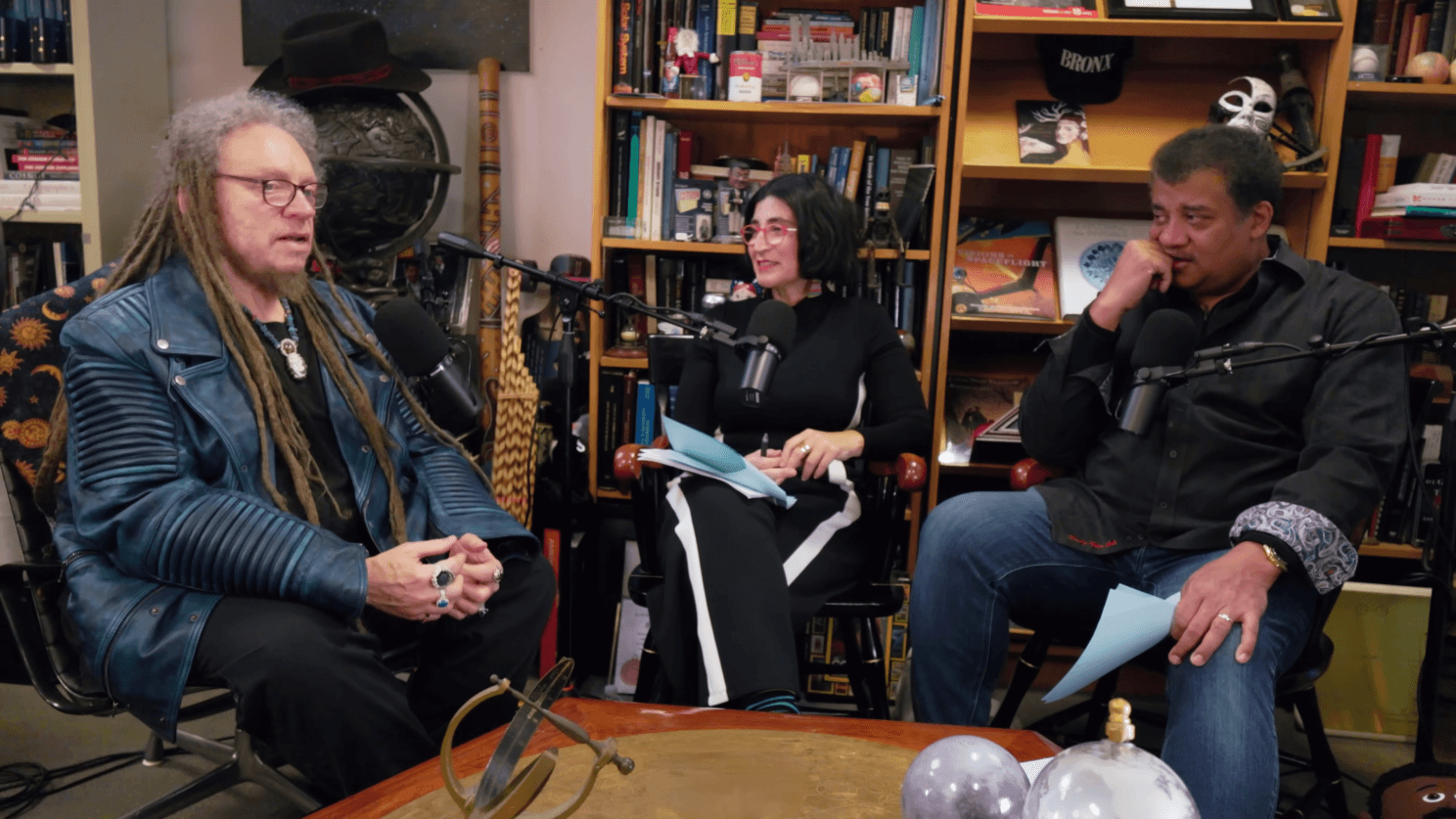
The reframe that started all of this came from Jaron Lanier on the StarTalk episode "There Is No AI, Really (It's Just People)." Lanier is credited with coining the term "virtual reality" in the 1980s and has spent the decades since as one of technology's most credible inside critics. His argument is simple: there is no AI, really. There are only people. The model is a massive, decentralized collaboration of everyone who made anything that ended up in a training set. It's a mirror. Once that framing lands, it doesn't leave. It's a memetic payload: an idea that, once it hits, changes how you see everything it touches.
For designers, this isn't entirely new. Every design decision encodes a model of how people think and what they need. The component library encodes a theory of hierarchy and relationships. The art direction brief encodes assumptions about what an image should make someone feel. That's also a description of how a large language model works: it draws on everything it absorbed to respond to new situations, building outputs from patterns learned across millions of inputs. Designers have been doing this their entire careers, building internal models from lived experience and applying them to new problems. What changed is the scale and the mechanism. Patterns that used to spread through an industry over the years now enter training pipelines and emerge in tools used by millions. The propagation is categorically different.
The fear that usually arrives here is job loss. It's legitimate, and in many industries it's already real. Companies have shed significant headcount under the banner of AI efficiency, often with weaker economic justification than the headlines suggested. A 2024 MIT CSAIL study found AI automation to be economically viable in only 23% of the visual roles it examined. The Yale Budget Lab found no widespread evidence of AI displacing jobs at scale. The market sold efficiency. It oversold it. The roles where real displacement is concentrated don't require design-level judgment. What a photograph should evoke in a specific community. What hierarchy means to someone navigating an unfamiliar system. AI changed the speed at which I reach the part where that judgment matters. The judgment is still ours.

I've been watching Pluribus on Apple TV. In the show, most of humanity joins an alien collective consciousness, content and smiling. The protagonist, Carol Sturka, is immune and furious about what everyone around her has given up. I understand that anger. The fascination I've been describing doesn't cancel it out. Mild spoiler for the middle of the season: Carol eventually finds one person she trusts. That maps to how I use these tools. Different models have different strengths and different failure modes. You develop something like a working relationship. More Carol than collective.
And it feels like a miracle. It also feels low-key destructive. They're the same thing at different zoom levels. William Powers mapped this pattern in Hamlet's BlackBerry: every major leap in communication technology lands with disruption before people learn to live with it. What made the transformative ones different was reach. The printing press, radio, and the internet each restructured how ordinary people encountered knowledge. Cryptocurrency never got there. You had to find the ecosystem and choose it. AI is already in the search bar and the word processor. Corporate interests embedded it before the cultural conversation caught up. At some point it will be as unremarkable as a calculator or a television. We've always arrived there eventually.

The reframe has started to reach policy. Senator Bernie Sanders announced the American AI Sovereign Wealth Fund Act last week, a proposal giving the public a 50% ownership stake in the largest AI companies through a one-time stock tax. His argument addresses both sides of what's happening: AI is built on collective human knowledge, and the wealth it generates is currently concentrating among a small number of investors while the workers whose output made it possible absorb the disruption. The bill is unlikely to pass. But a sitting senator making this case in the New York Times tells you the recognition is no longer fringe. We built this. It makes sense that we'd eventually say so.
The reframe doesn't just change how you see AI. It changes how you see your own work. An experienced designer brings something to a brief that no model can learn from aggregate data: knowing the specific person the work is actually for. That knowledge was never in the training data. It's in the room.
I'm a designer who works in these tools every day. The reframe changed how I see them.
We aren't being replaced by AI. We are its foundation.
—-
How are you thinking about AI and your own work right now? I'd love to hear it in the comments.
—-
Sources
Jaron Lanier — "There Is No AI, Really (It's Just People)" — StarTalk with Neil deGrasse Tyson
Neil Thompson et al. — "Beyond AI Exposure: Which Tasks are Cost-Effective to Automate with Computer Vision?" — MIT CSAIL / Initiative on the Digital Economy, January 2024
"Tracking the Impact of AI on the Labor Market" — The Budget Lab at Yale University
Bernie Sanders — Op-ed — The New York Times, June 1, 2026
William Powers — Hamlet's BlackBerry: A Practical Philosophy for Building a Good Life in the Digital Age — HarperCollins, 2010
Pluribus — Created by Vince Gilligan — Apple TV+, 2025

