The researchers at Pitt CTSI don't get their names on the breakthroughs. They make the breakthroughs possible. More than 2,000 investigators have worked through the institute. More than 4,000 studies have moved forward because of it.
Client
University of Pittsburgh
Agency
Wondros
Role
Art Director
Year
2017–2018
Scope
Art Direction, Visual Identity, Photography Direction, Illustration Direction, Design System
Celebrate the lives and work of the people at CTSI
University department sites accept being forgettable. I didn't want to accept that here.
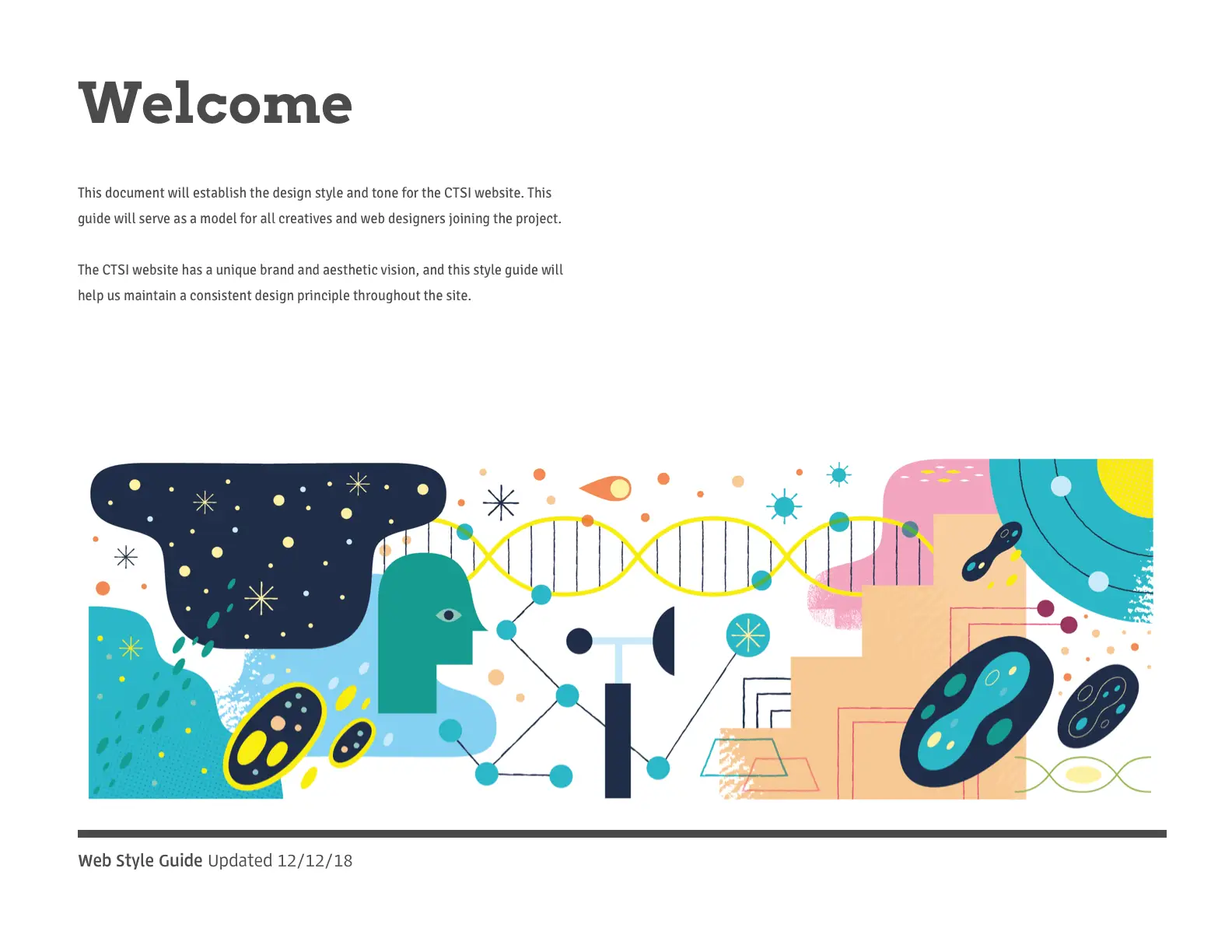
The opportunity was to give this institution a sense of place. Visual language that reflected the people inside it and honored what they contributed. I presented a comp that made that argument. They bought in.
*designs are from a previous direction which used another logo and certain content. Please see the live CTSI site for the latest.

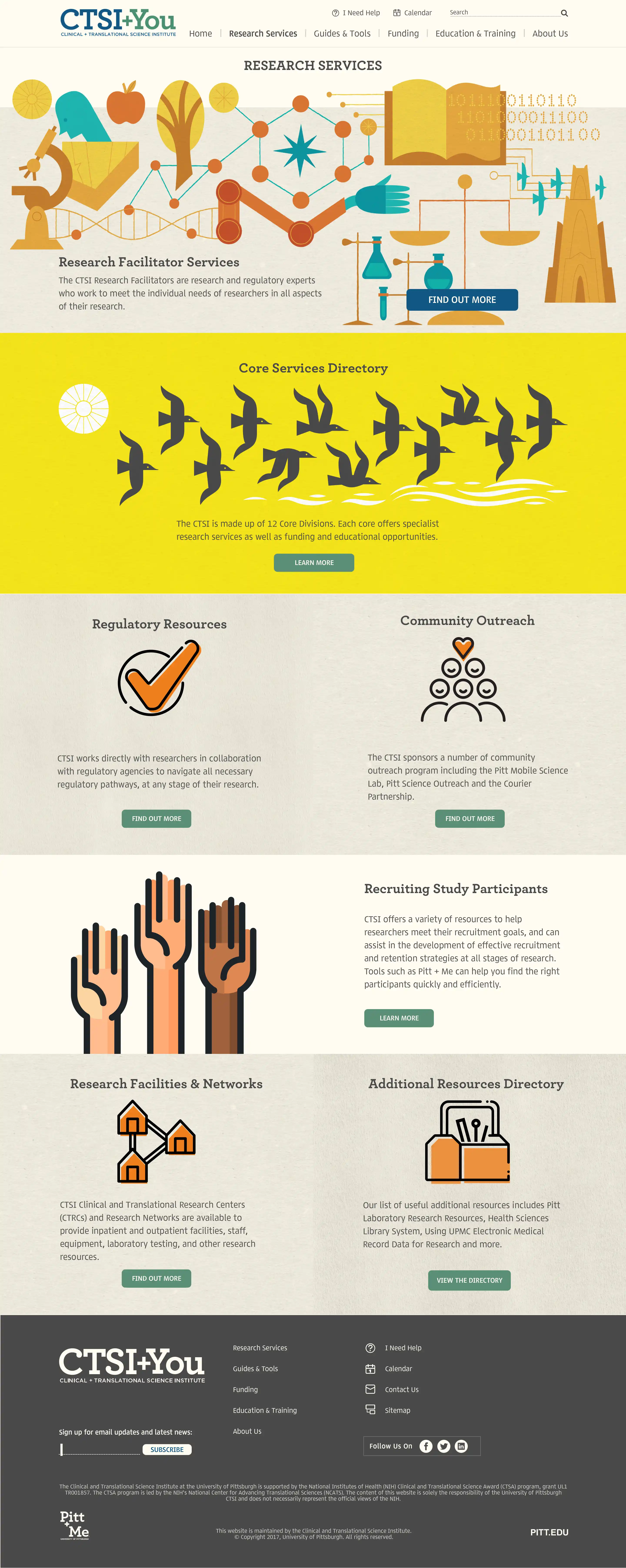
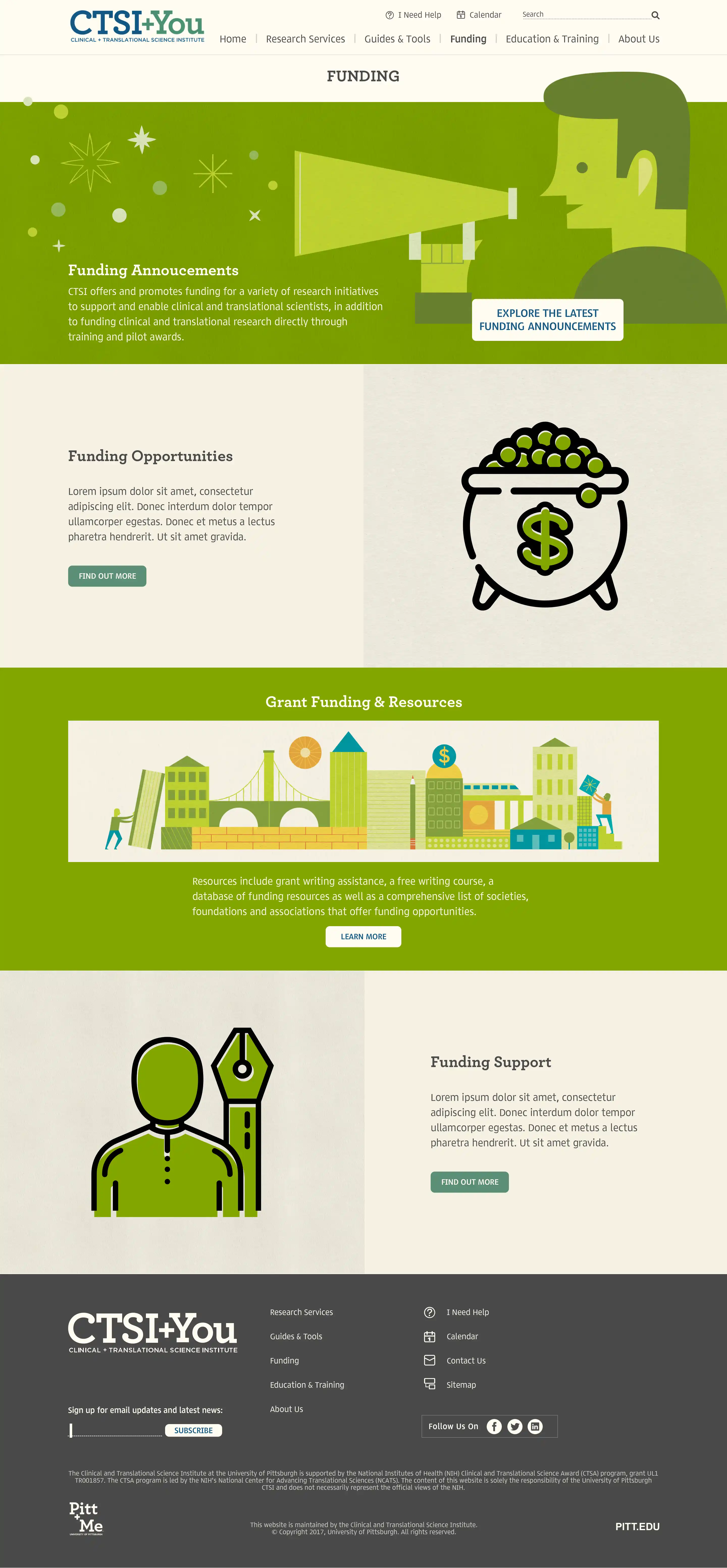

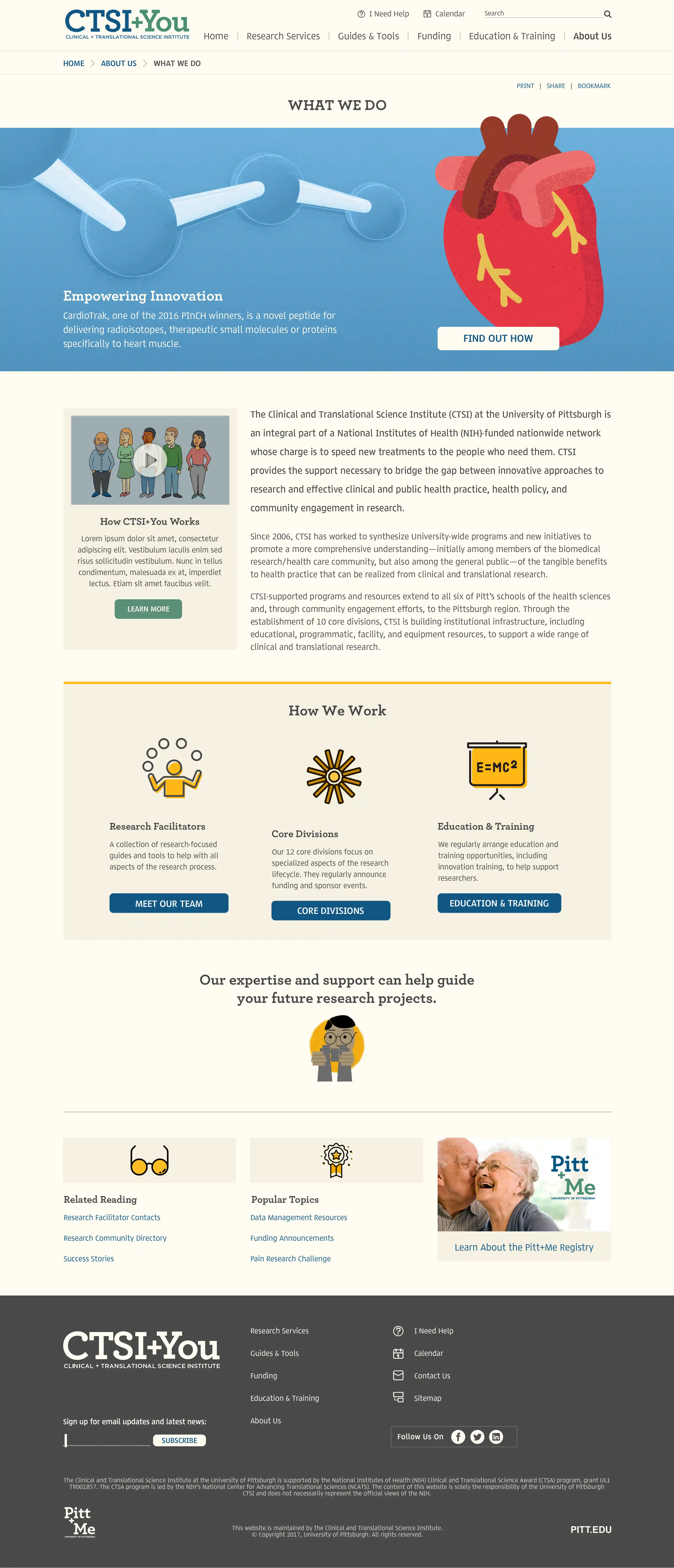
Civic art
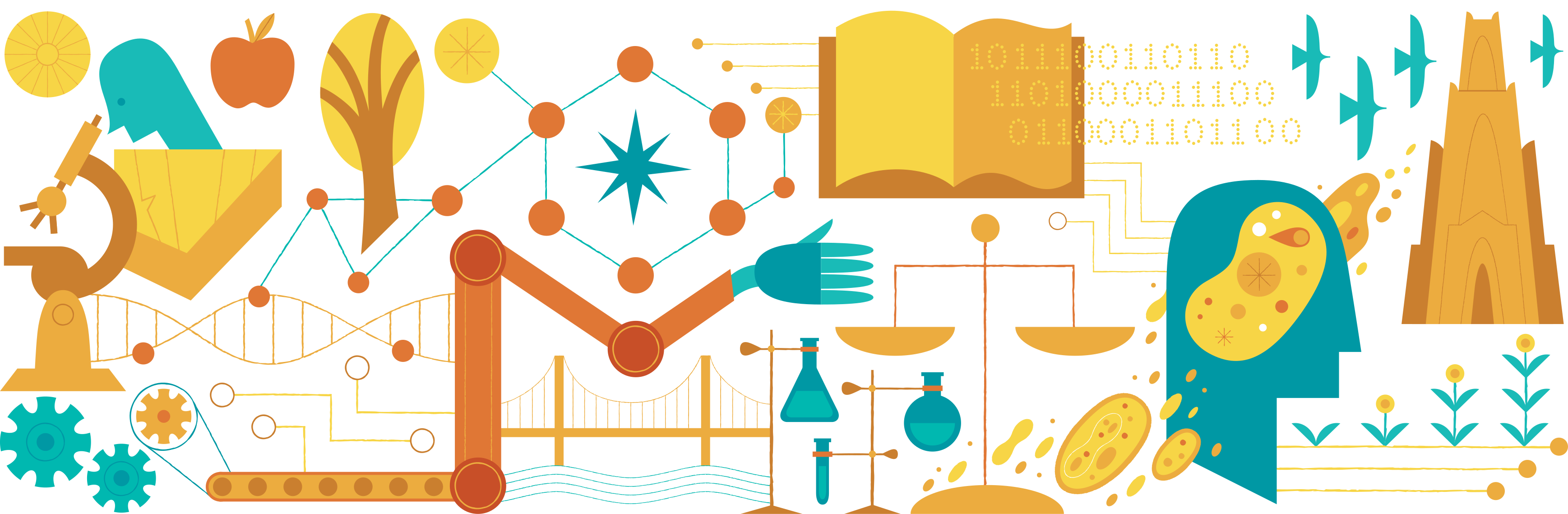
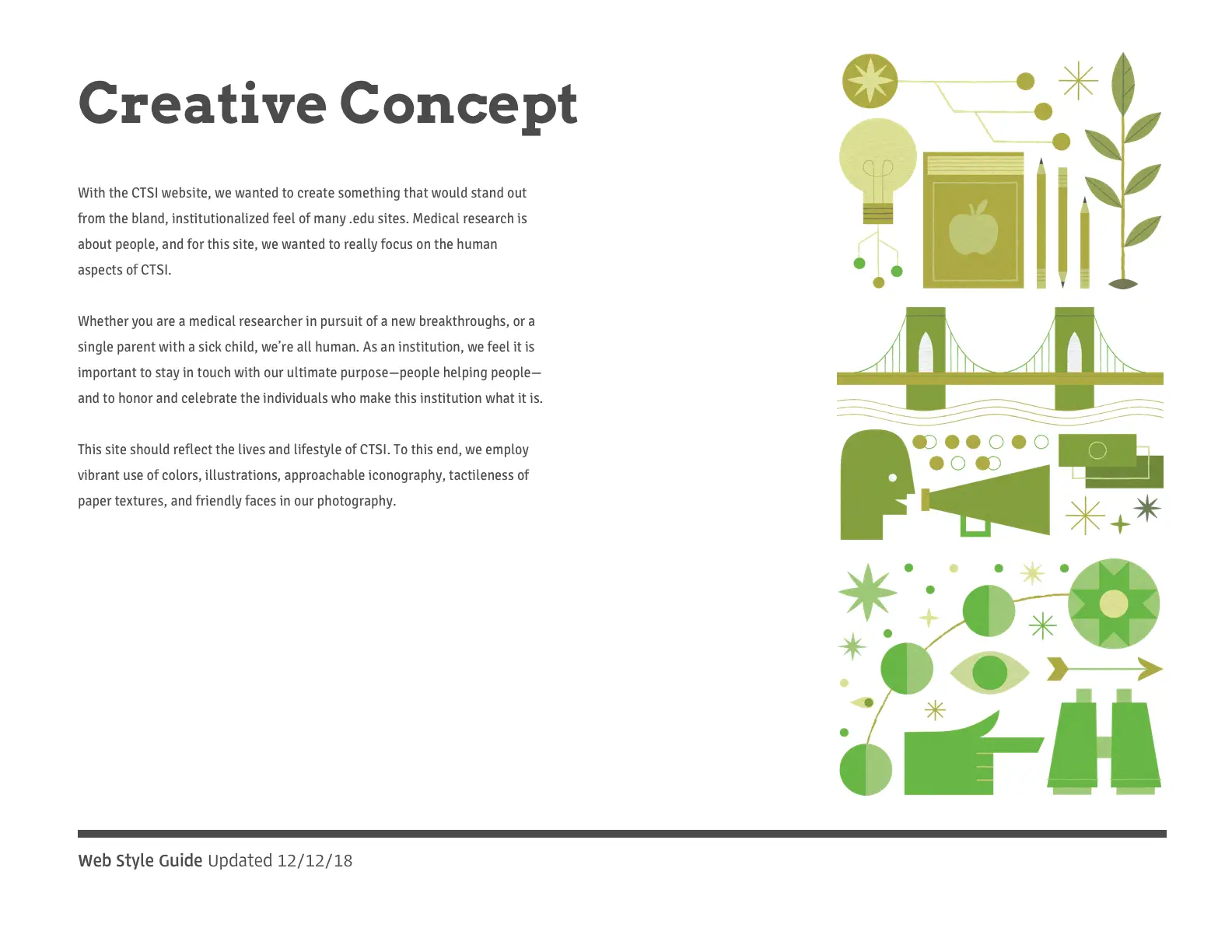
The concept has a name in urban design: placemaking. The idea that public spaces should communicate who their people are and why they matter. Cities invest in civic art and public sculpture because belonging is real. I wanted to bring that language to CTSI.

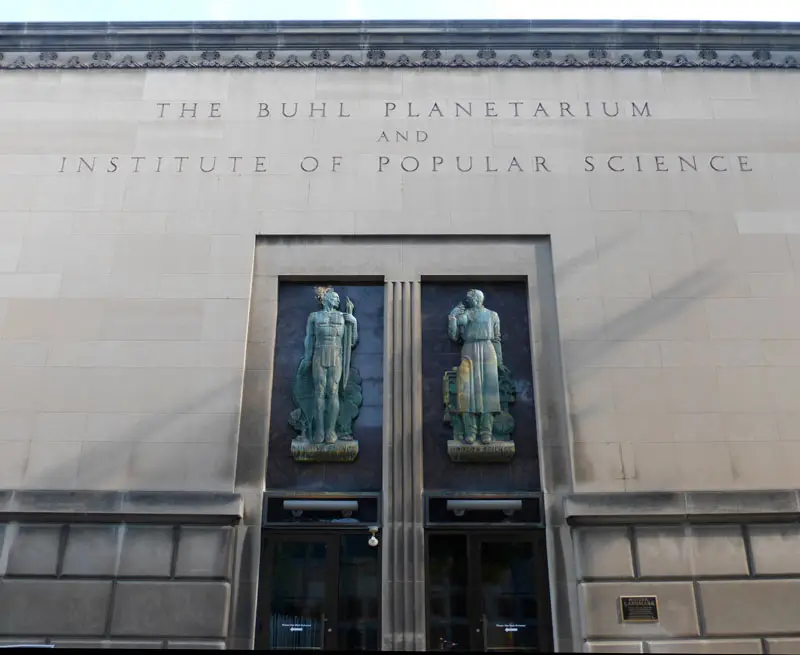

L→R: Millard Sheets, Sidney Waugh, Jen Stark
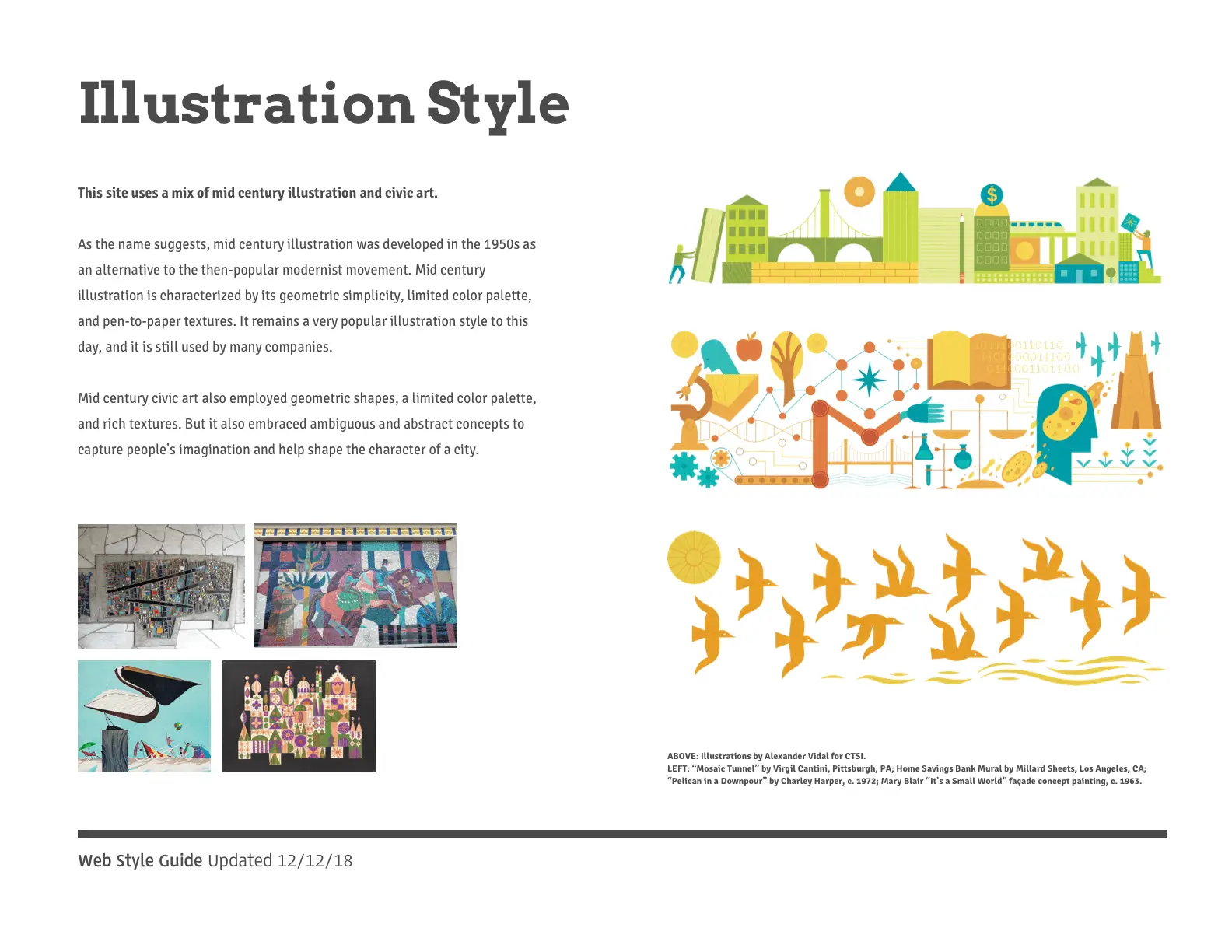
The reference images in the style guide named the tradition directly: Virgil Cantini's Mosaic Tunnel in Pittsburgh, Millard Sheets' Home Savings Bank Mural in Los Angeles, Charley Harper's Pelican in a Downpour, Mary Blair's It's a Small World façade painting from 1963. Mid-century civic illustration: geometric, warm, built to give an institution a sense of place.

Cantini's civic art had been at Pitt for decades. His Science and Mankind mural at the Chevron Science Center and Man sculpture at the Graduate School of Public Health both honored the same health sciences community CTSI serves.
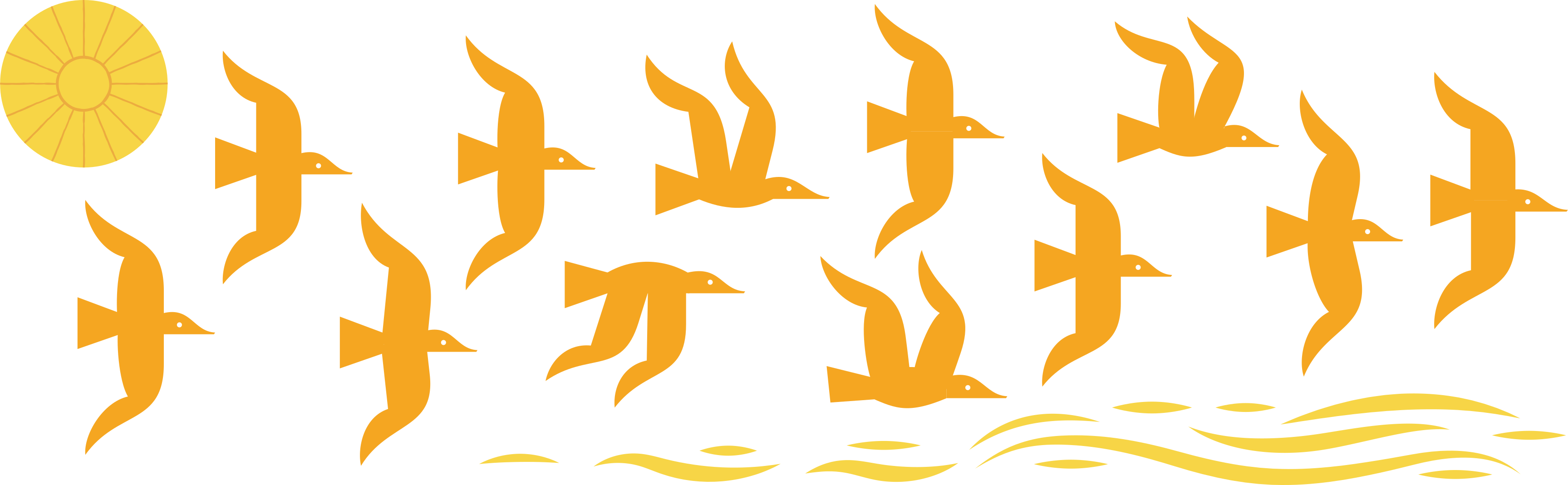
Alexander Vidal was already in the tradition. His clients: the California Academy of Sciences, the Monterey Bay Aquarium, and the Natural History Museum of Los Angeles. They said everything about where his sensibility lived. We worked toward illustrations that felt rooted in that civic tradition.



Texture, color, and connection
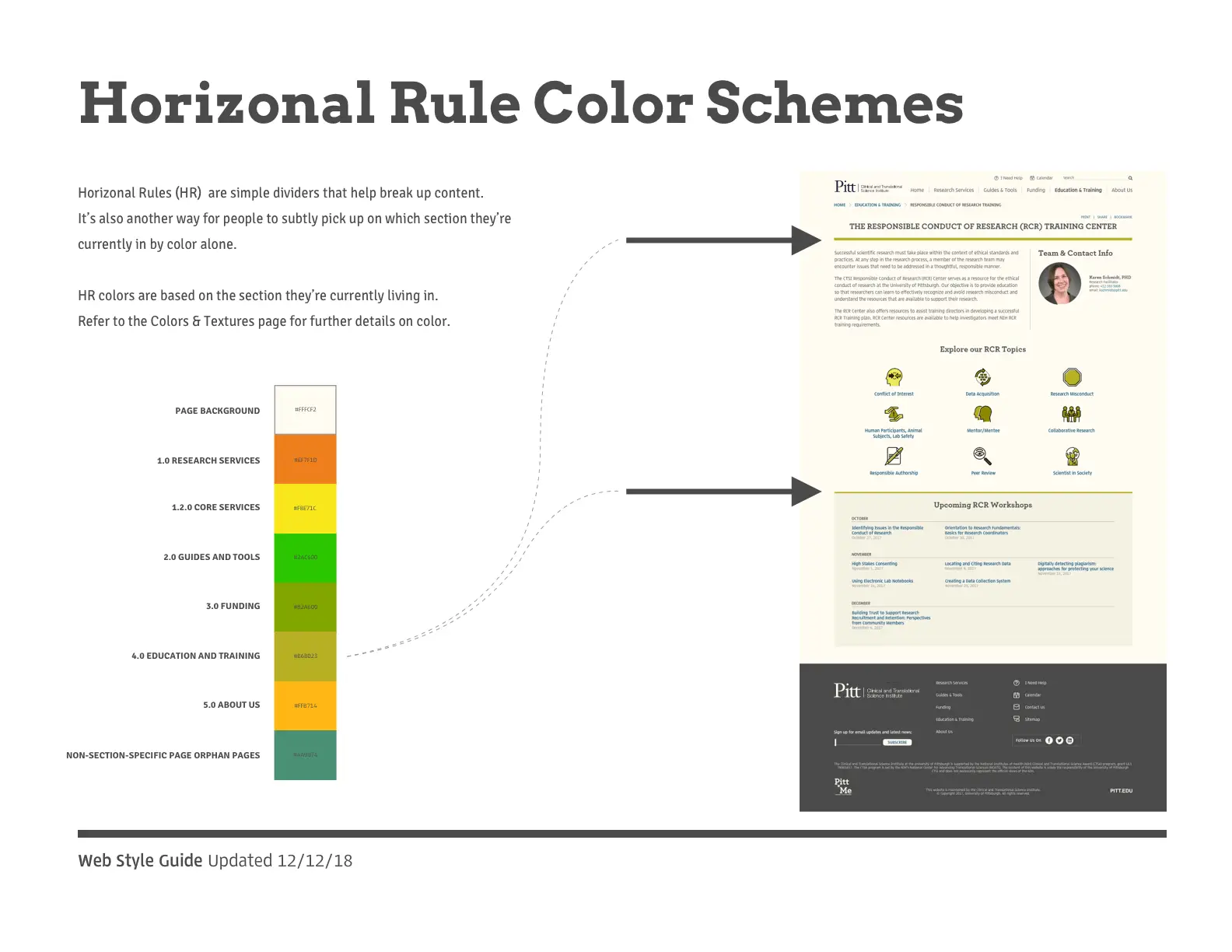
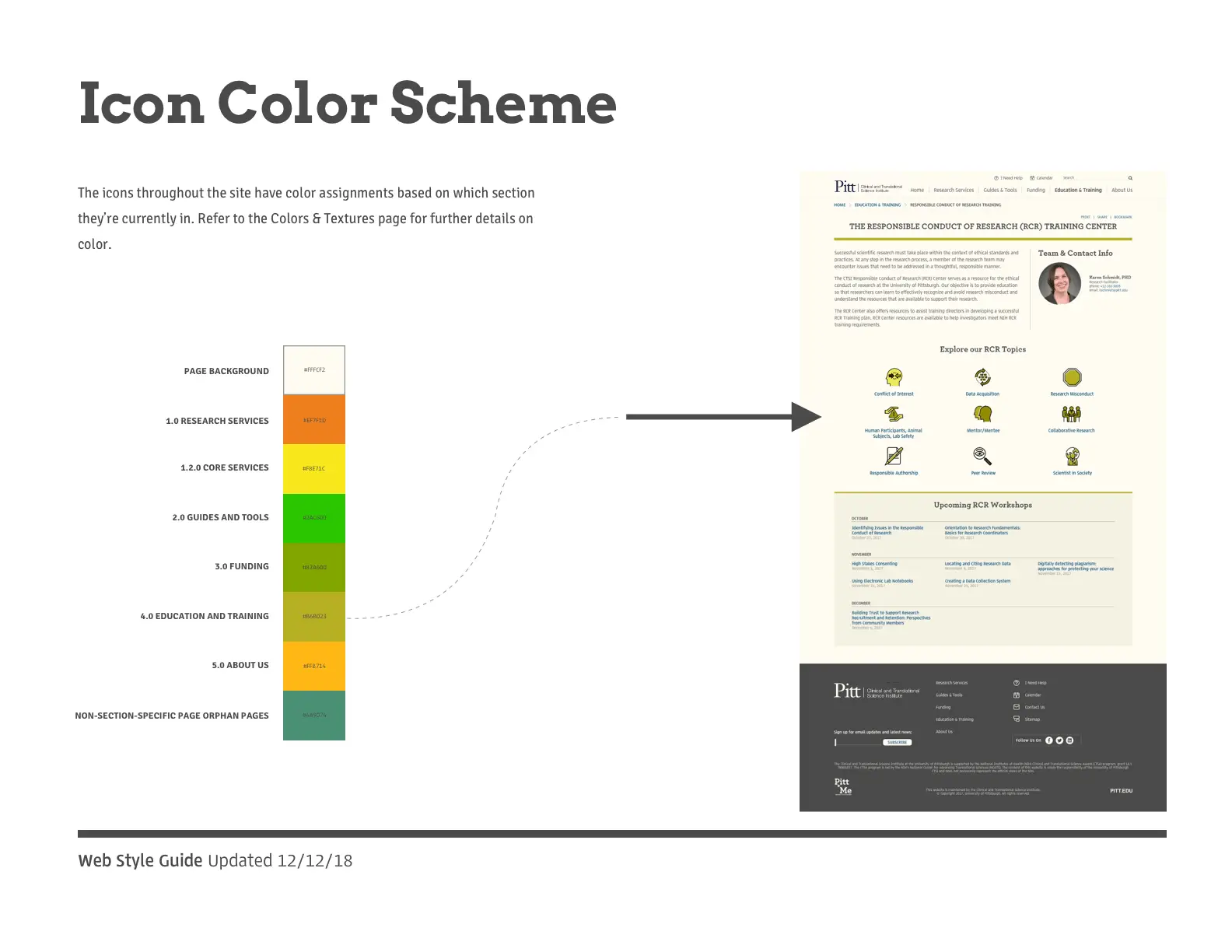
Each section of the site had its own color: orange for Research Services, yellow for Core Services, vivid green for Guides and Tools, deeper greens and ambers for Education and Funding. White cardboard and kraft paper textures ran beneath, grounding the site in something tactile and physical. Color became wayfinding. A sense of place before a word was read.
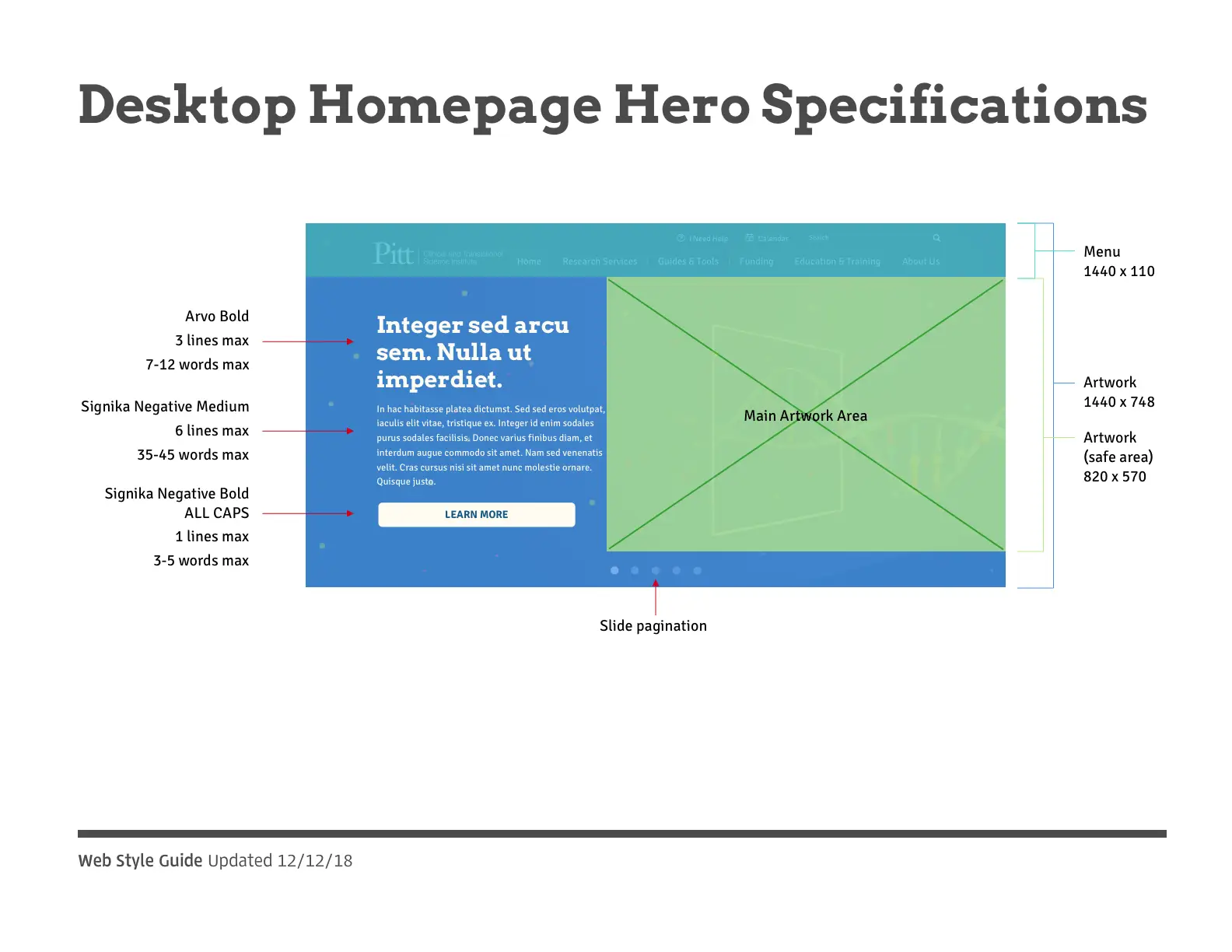
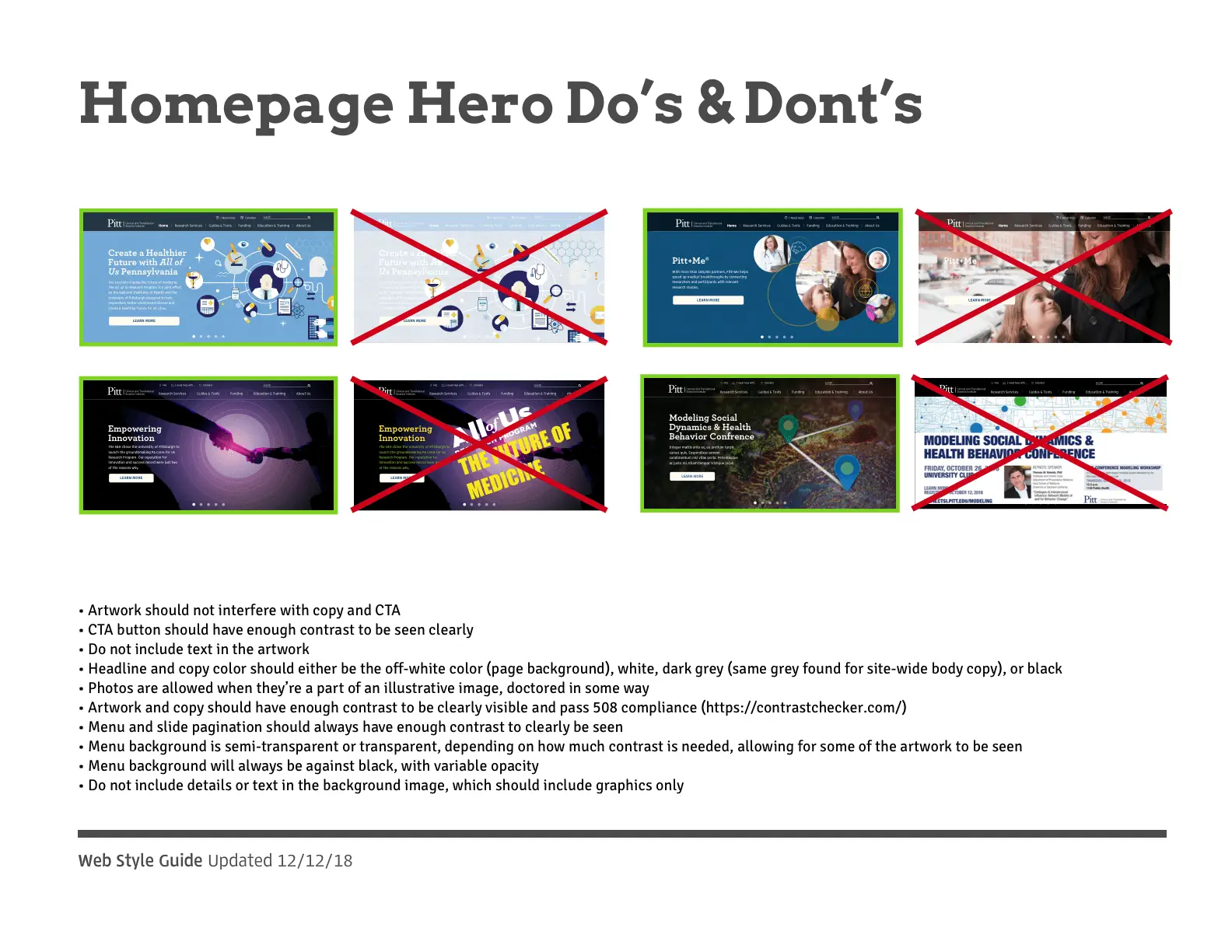
Each homepage hero was treated as a science magazine cover. High-concept and illustrative, the kind of visual that makes research feel alive.

The people
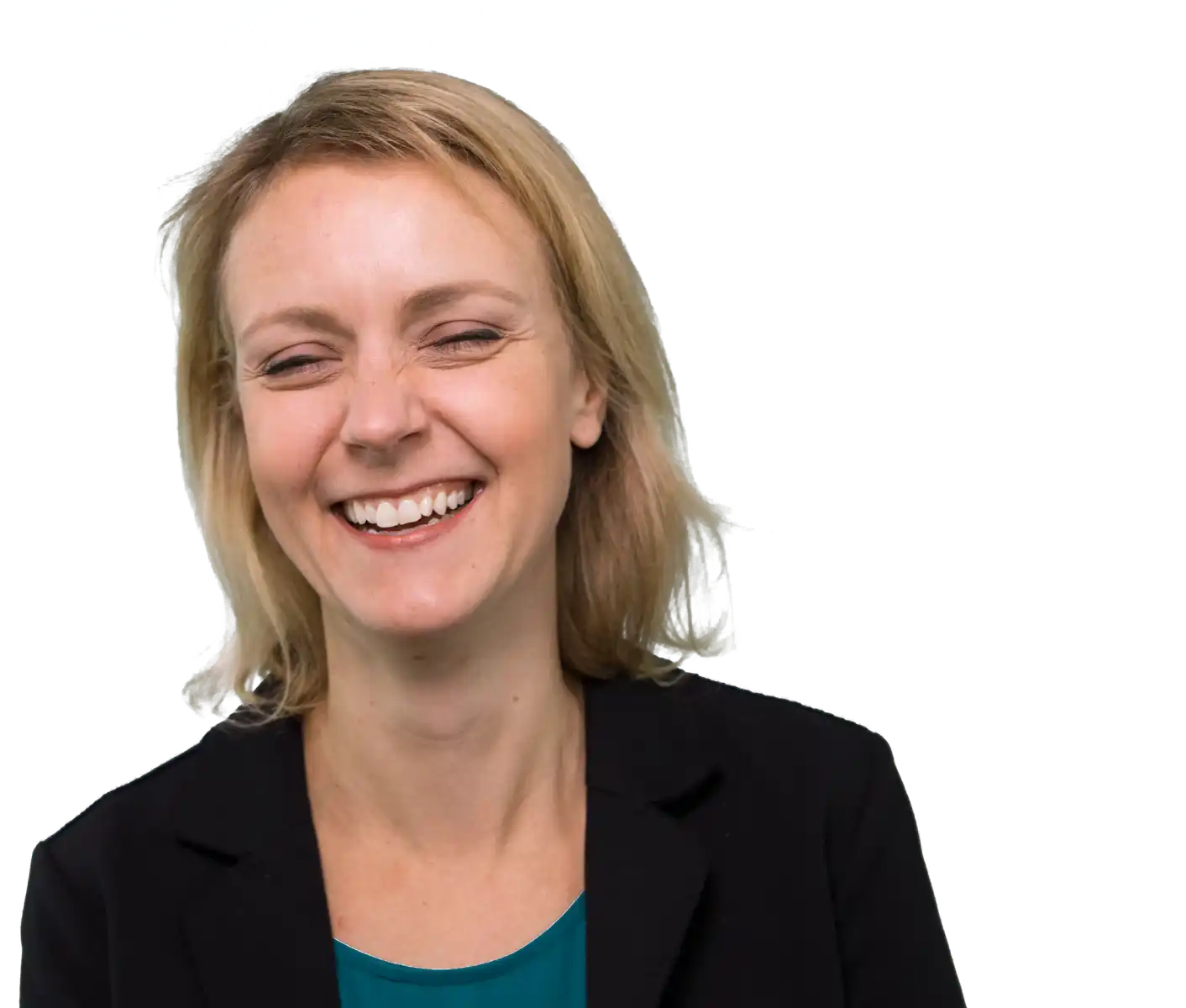
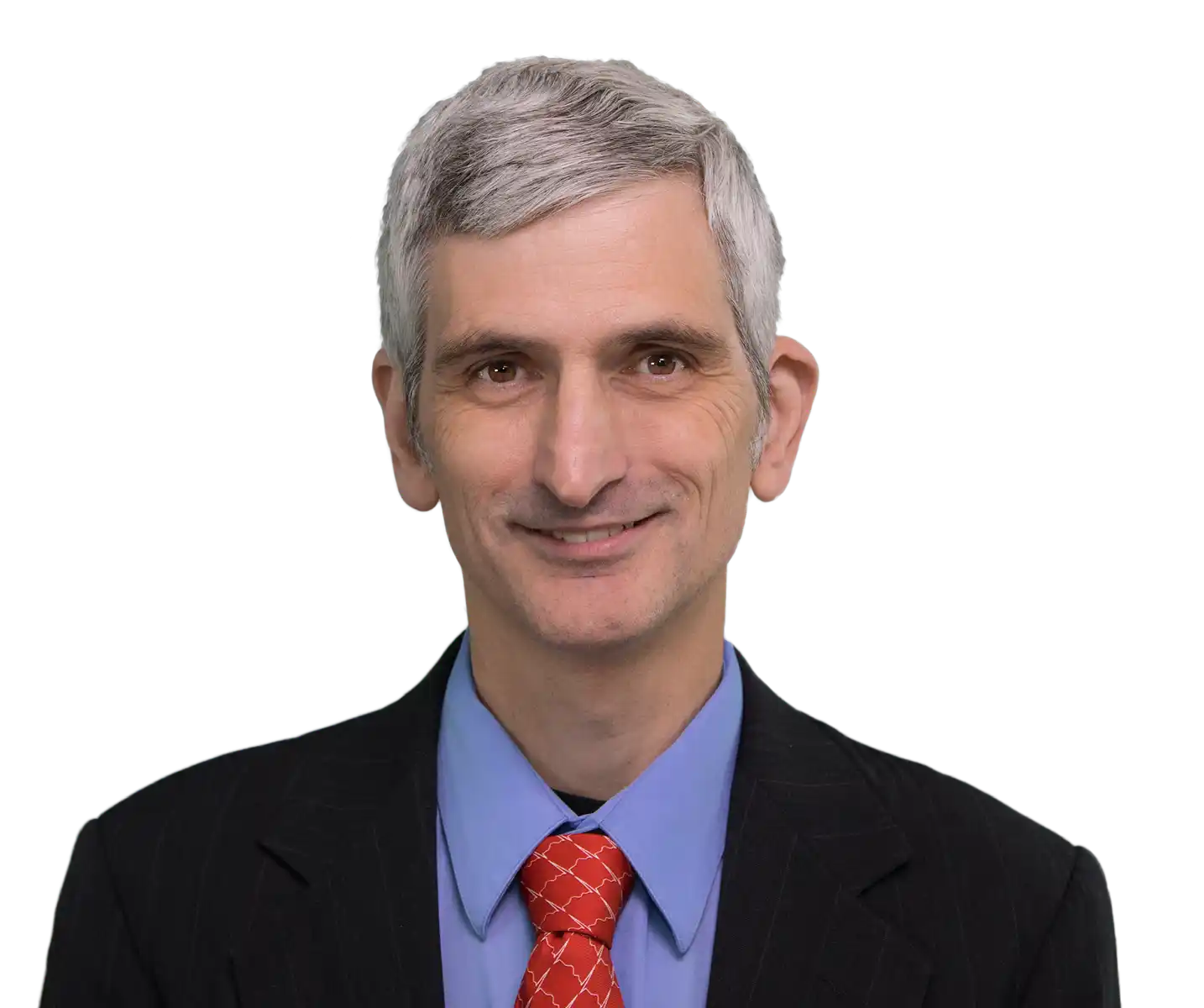
The photography brief was specific. Every staff member submitted three images: one smiling, one showing personality, one in profile. Staff photography is almost always frontal. A credential shot, filed and forgotten. The profile was the decision. It gives the subject dimension, a face worth seeing from more than one angle.
Thirty-two people sat for portraits in an on-site studio because they understood what we were making.














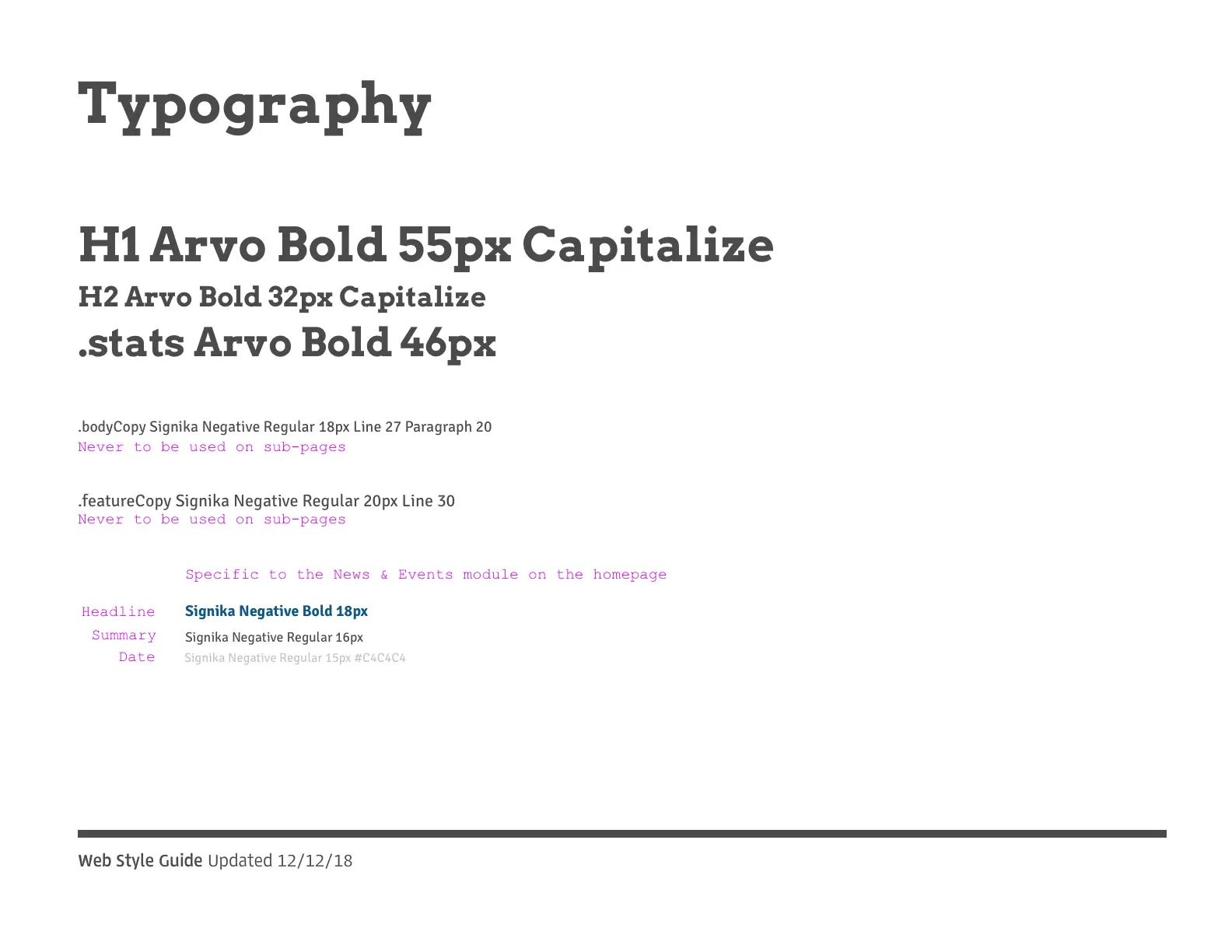
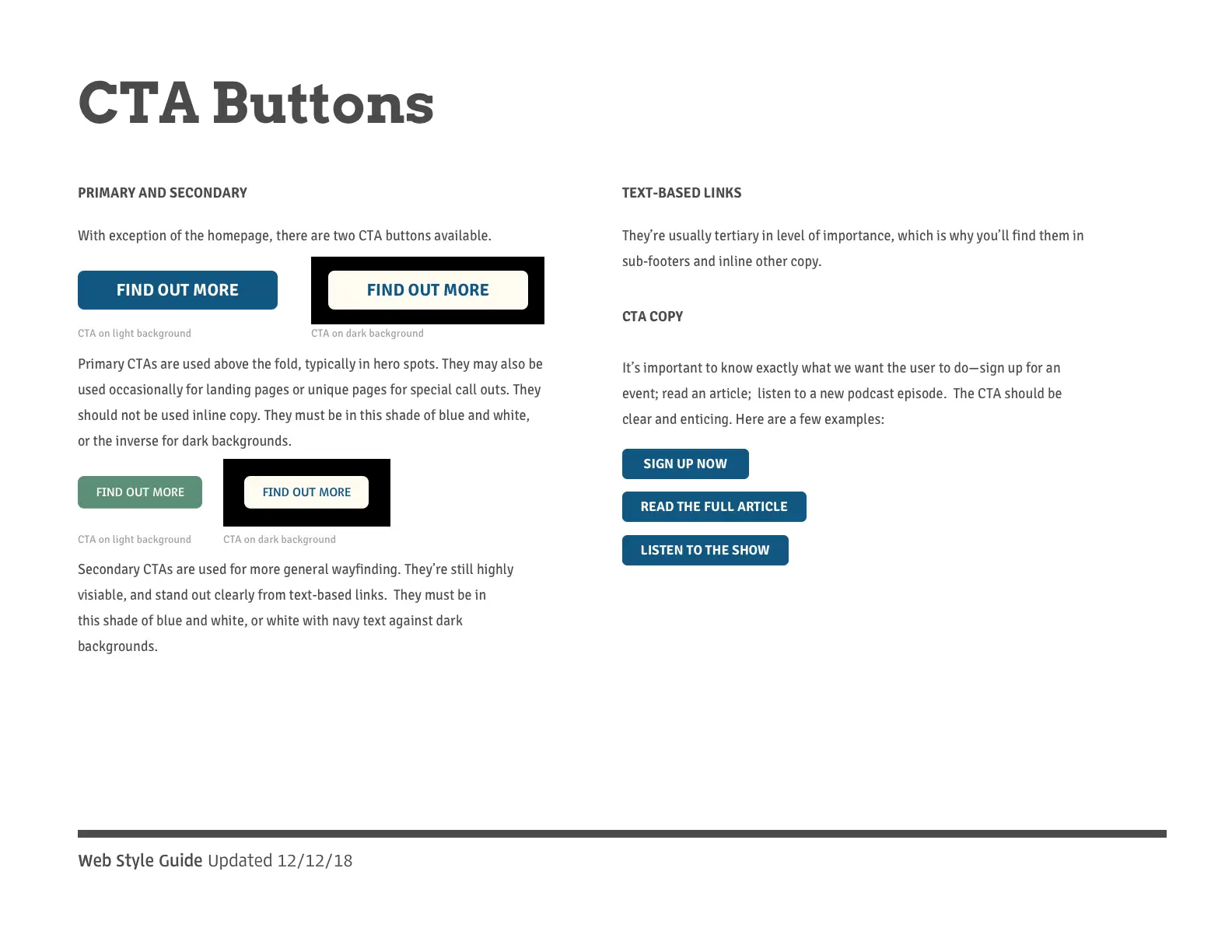
A full web style guide documented the creative concept, illustration references, color and texture system, homepage specifications, and component rules. Built to outlast the engagement.

Still standing
The system is still in use. A design that outlasted the engagement and the moment it was made for.
Credits
Art Direction: John Hultman
UX Strategy and Design: Brigid Buckman
Illustration: Alexander Vidal
Executive Digital Producer: Jennifer Eno
Director of Product Design: Lucinda Brown
Digital Producer: Melanya Torosyan
Sr. Project Manager: Camila Fernandez
Sr. Design Researcher and Strategist: Guy Horton
¹ NIH Revitalization Act of 1993 (P.L. 103-43), signed June 10, 1993. NIH Policy and Guidelines on the Inclusion of Women and Minorities as Subjects in Clinical Research. orwh.od.nih.gov
² CDC, "The U.S. Public Health Service Untreated Syphilis Study at Tuskegee." Study conducted 1932—1972. cdc.gov/tuskegee/about
³ Duke University Medical Center Library, "All of Us Research Program" guide. Updated February 6, 2026. 804,000+ participants, 440,000+ electronic health records, 568,000+ biosamples. guides.mclibrary.duke.edu
â´ SDSU Library, "All of Us Researcher Workbench" guide. "Information about over 6,000 research projects using All of Us data." library.sdsu.edu
âµ Denny, J.C. et al., "The All of Us Research Program," New England Journal of Medicine, 2019. 230,000+ participants enrolled by July 2019; 80% from communities underrepresented in biomedical research.
©2026 HU__MAN (John Glenn Hultman). All Rights Reserved. Do not repost without notification and attribution.