Trust was the design problem. The NIH All of Us program had $600 million and a mandate to enroll one million Americans, at least half from communities with every reason to distrust medical institutions. My team at Wondros was their creative partner, and I joined as Senior Art Director during the pre-launch phase. The task was to design a visual identity and participant experience that could earn it.
Client
National Institutes of Health
Agency
Wondros
Role
Senior Art Director
Year
2017–2020
Scope
$600M federal initiative
Results
participants enrolled during pre-launch and early enrollment. 80% from underrepresented communities, exceeding program targets.⁵
institutional partners using the design system.
won against two designers in Wondros' homepage competition, then won again against three designers in SCRIPPS' competitive redesign.
Today, All of Us has enrolled more than 800,000 participants. Over 80% are from communities historically underrepresented in biomedical research. More than 440,000 have shared electronic health records, and over 6,000 approved research projects are using the dataset.³⁴
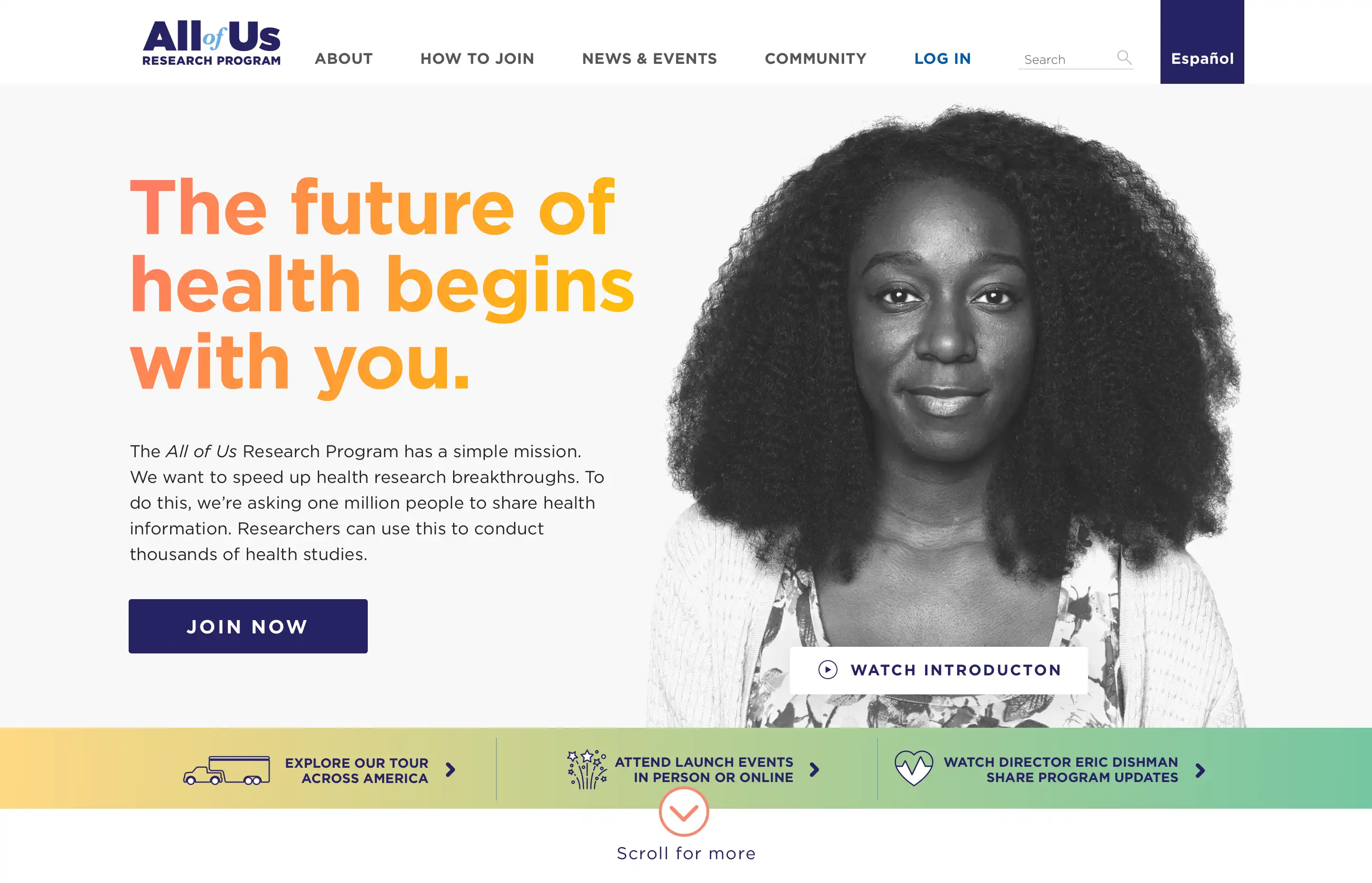
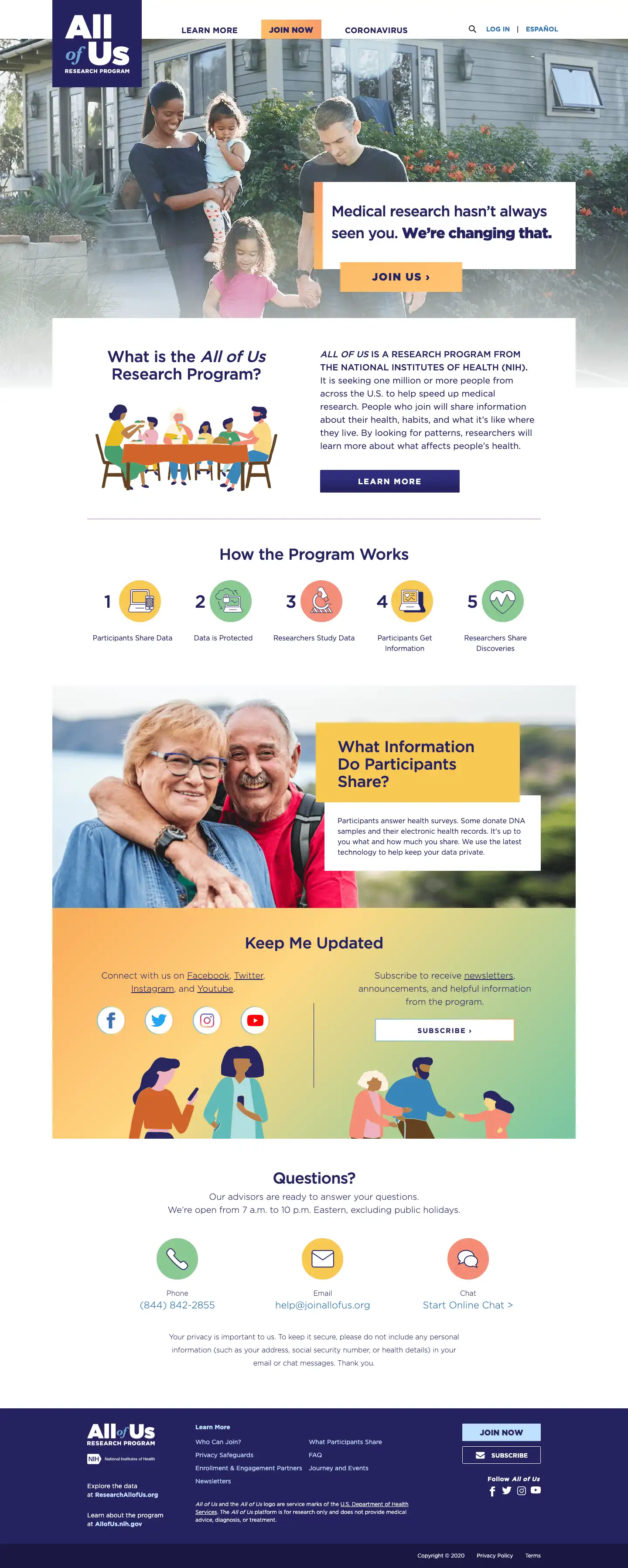
All of us Homepage — Prelaunch Hero
The Problem
People visiting the website were confusing the research program with a healthcare provider and calling in to ask about doctors' offices. The visual identity didn't distinguish research enrollment from healthcare delivery. For a program asking people to hand over their most personal data, that confusion was actively eroding trust.
And trust was the entire design problem. Women and communities of color were historically excluded from clinical research. Federal law mandating their inclusion didn't exist until 1993.¹ The Tuskegee syphilis study withheld treatment from Black men for forty years.² NIH was explicit: if the design didn't account for that history, the program would fail. This was an organizational problem carrying the weight of decades of institutional betrayal.
All of us Homepage — Before

All of us Homepage — After

My Approach
I wasn't originally on this project. While the team was deep in the All of Us pre-launch, I was art directing another Wondros engagement: a visual identity and design system for the University of Pittsburgh's Clinical and Translational Science Institute. But I had a clear vantage point into All of Us, and I could see the problem described above before the team inside it could name it.
After that project wrapped, I was asked to take a crack at the homepage redesign. Wondros brought in two other designers to compete. I delivered three concepts, each built around two questions: How do we increase sign-ups? How do we address misinformation and distrust?
The work was presented internally, then shared with NIH. They selected my first concept and asked for a hybrid solution that merged the new direction with existing site elements. That hybrid became the foundation for everything that followed.
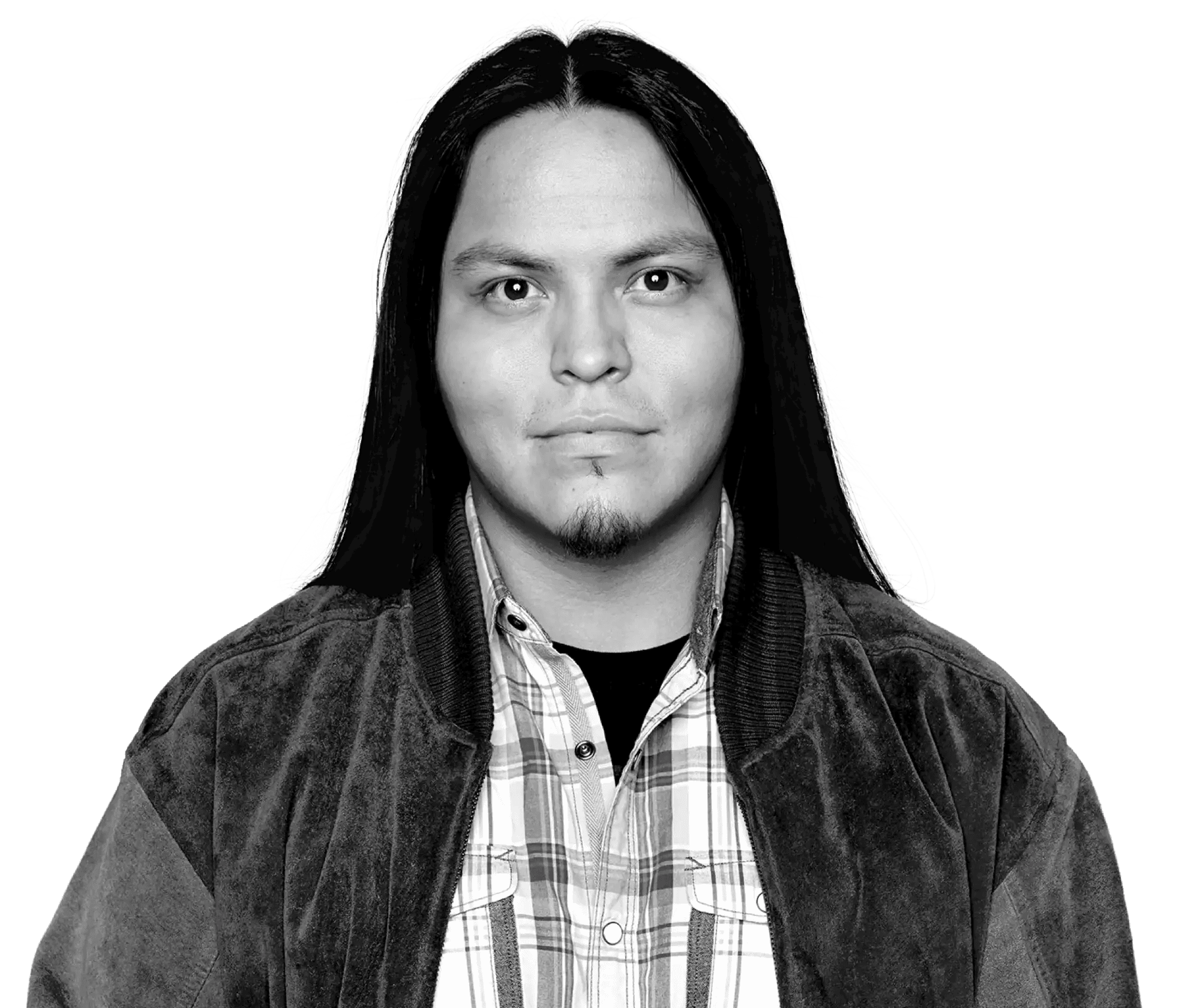


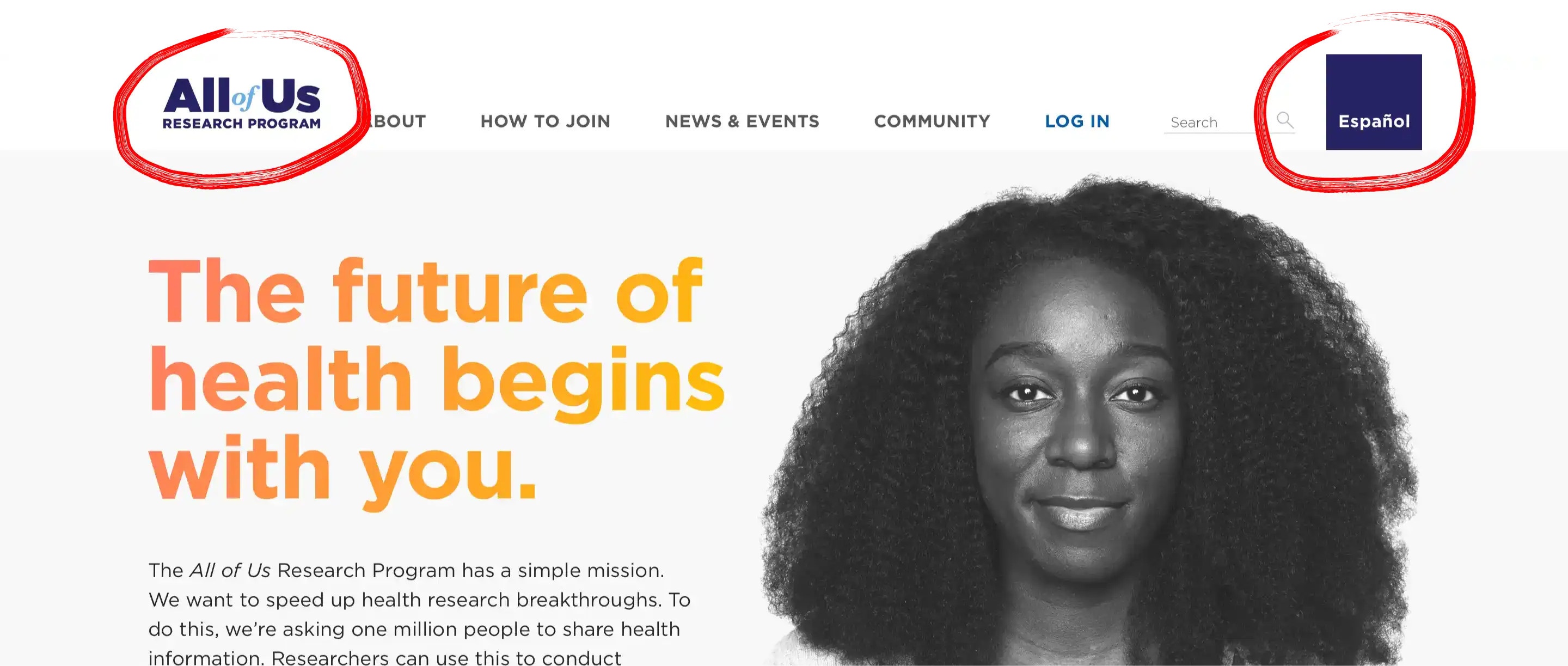
This was a system: photography, illustration, color, and typography that needed to flex across 100+ institutional partners without breaking. If the system needs explaining, it's already failed. I built it to be self-evident and to outlast me, and it did. The system survived a creative director transition and national scaling. When SCRIPPS later took over the website and held a competitive redesign (again pitting my direction against three other designers), the visual identity I'd established won again.
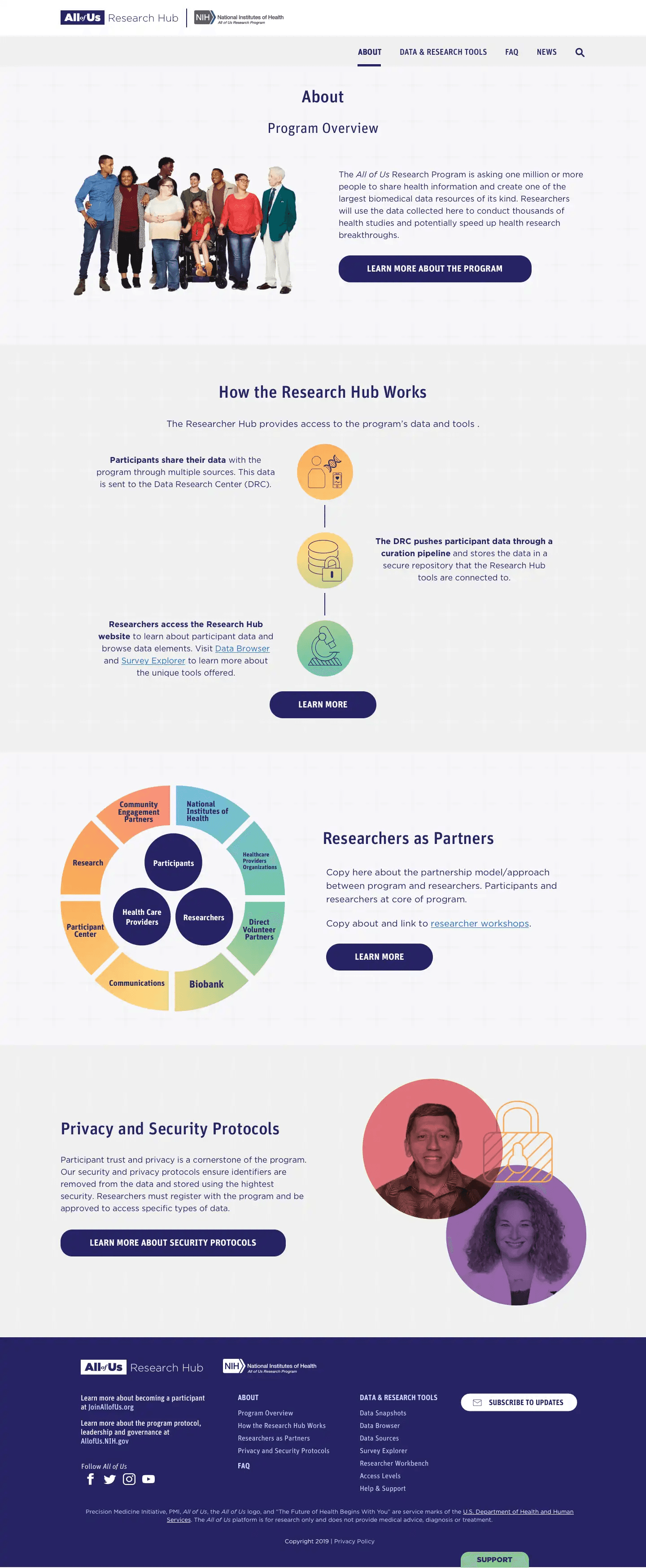
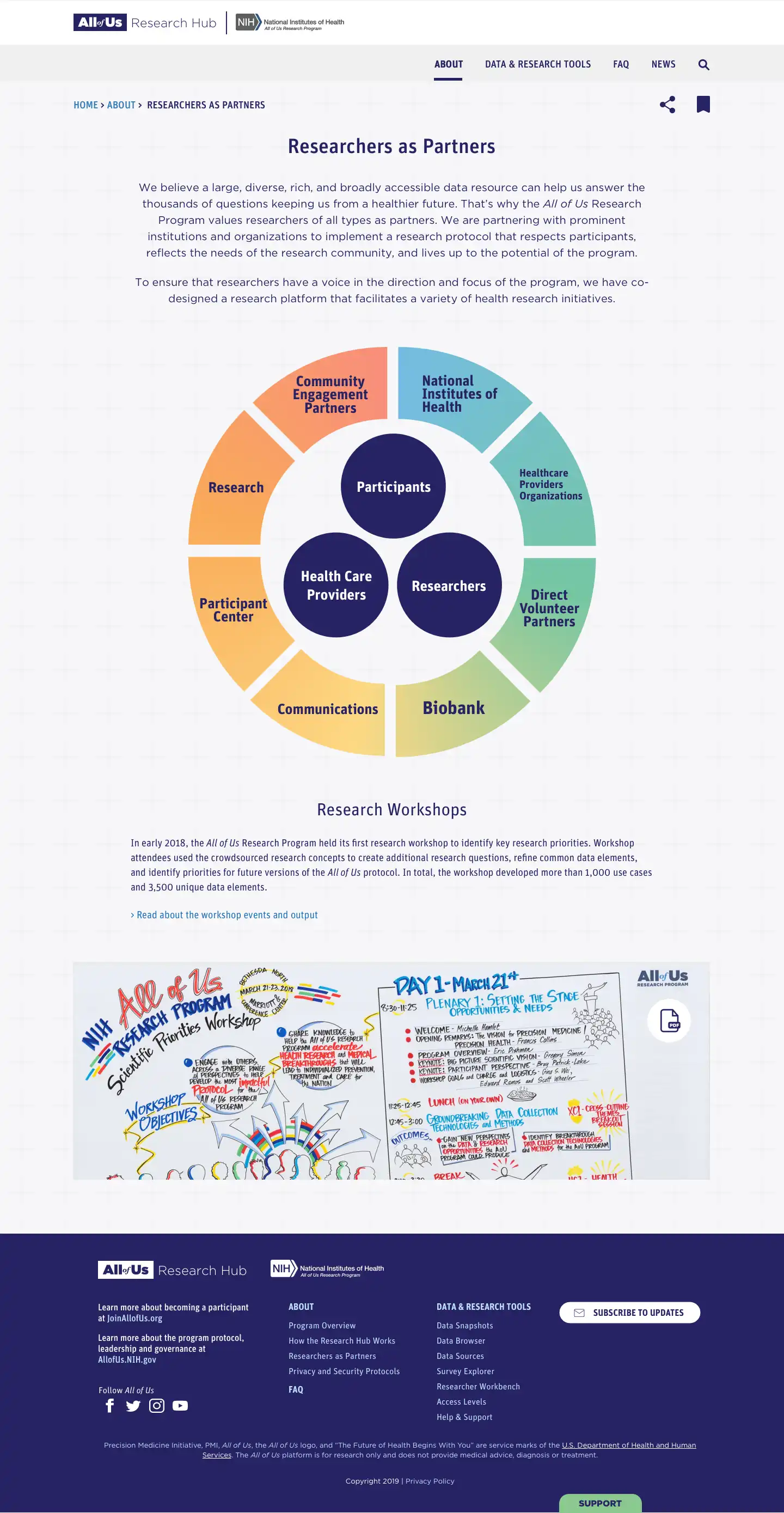
Research All of Us
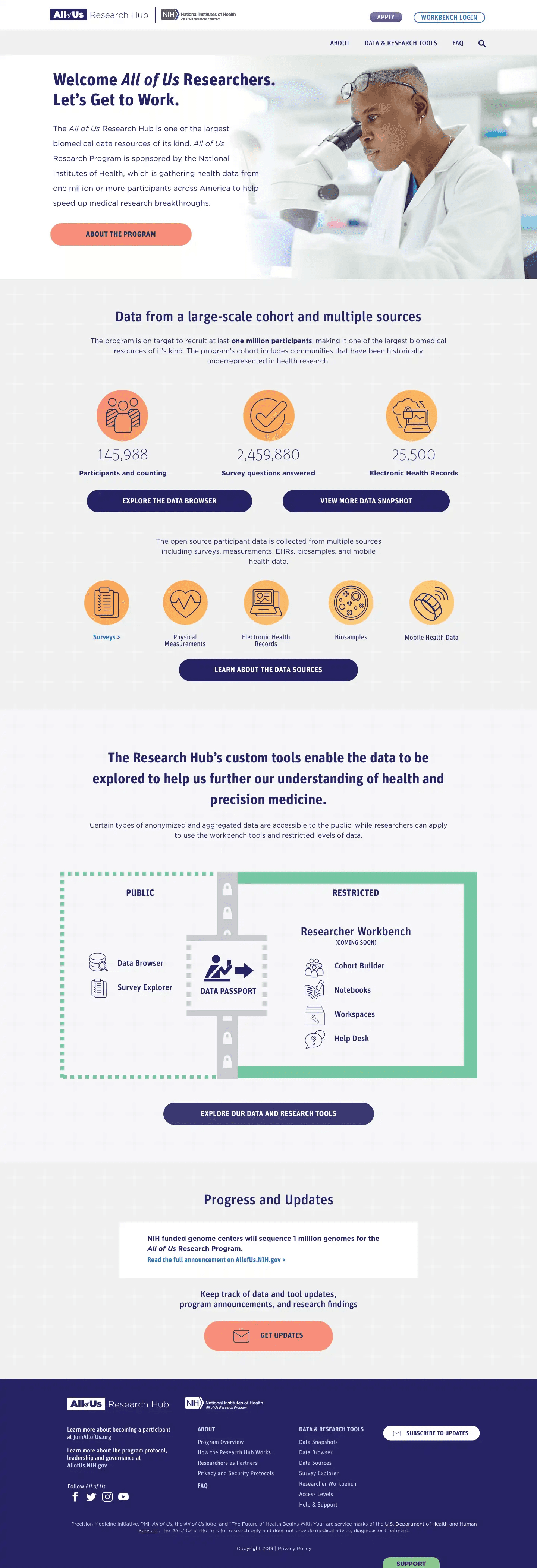
All of Us also needed a home for the researchers using the dataset. Different audience, different problem. The Researcher Hub took the same visual identity and refined it into something more functional and tool-like, without losing the warmth that earned participants' trust in the first place. Same system, different register.
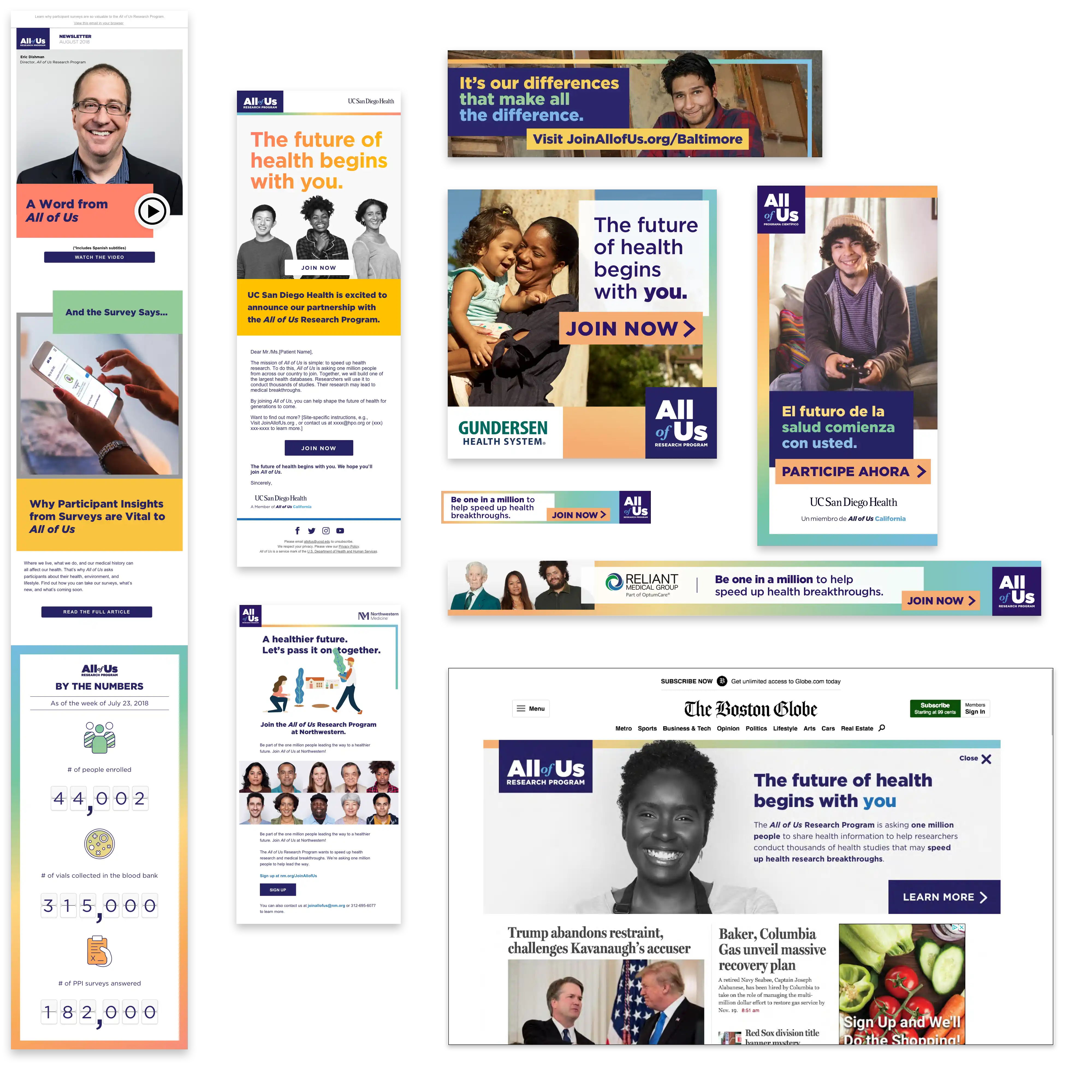
Paid Media and Email
The system had to live everywhere the program lived. Hundreds of banners, emails, OOH placements, and animated HTML units, in English and Spanish, across institutional partners and direct-response channels.
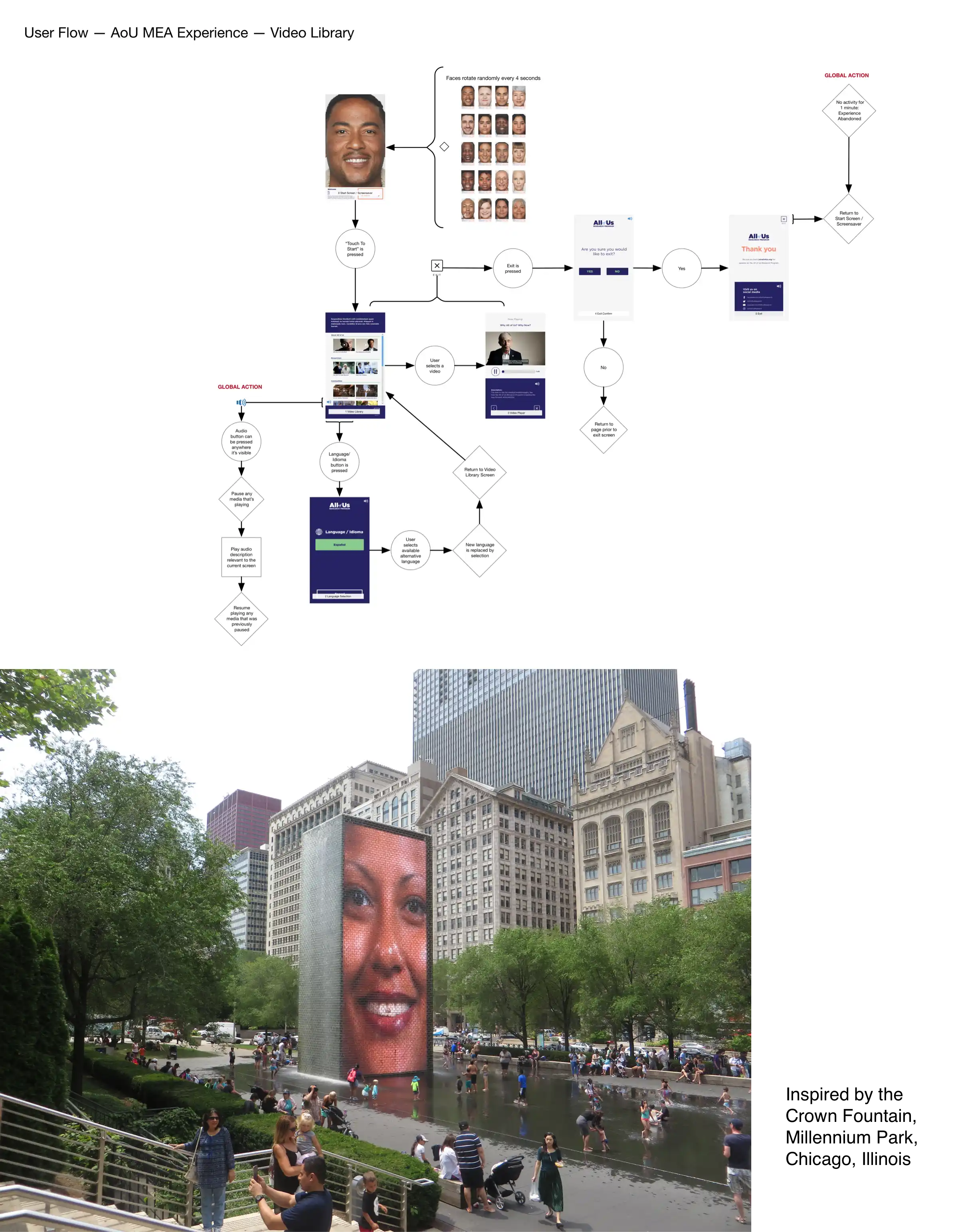
Traveling Exhibition
The program needed to reach people who weren't searching for it. The Mobile Unit was a traveling exhibition: a trailer of interactive kiosks, a Guest Book, and a video experience that let people see themselves reflected in the program before deciding to join. I led the UX, visual direction, and prototyping, carrying the identity off the screen and into a space people walked through.
All of us Guest Book

All of us Guest Book


All of us Video Kiosk

The Mobile Unit toured the country. Local news picked it up along the way. This clip is one example of the system working in the wild: kiosks, signage, photography, all doing their part.
Second Redesign
Three years on, the SCRIPPS team in San Diego took over the site and held a competitive redesign of their own. The visual identity I'd established went up against three new directions and won again.
A system earns trust by outlasting the person who built it. This one did.
Credits
Executive Digital Producer: Jennifer Eno
Executive Director of Digital: Brad Combs
Creative Director: Jason Bacasa
Director of Product Design: Lucinda Brown
Senior Art Director: John Hultman
Digital Producers: Melanya Torosyan, Michael Hopkins Sr.
Project Manager: Amy Barton
UX Strategy and Design: Brigid Buckman
UI Design: Terry Ma
Copywriter: Ryan Curtain
Design Team: Steven Rahbany, Brett Meier, Vanessa Ong, Ebony Darby, Amanda Cabasa
Agency: Wondros
Client: National Institutes of Health
¹ NIH Revitalization Act of 1993 (P.L. 103-43), signed June 10, 1993. NIH Policy and Guidelines on the Inclusion of Women and Minorities as Subjects in Clinical Research. orwh.od.nih.gov
² CDC, "The U.S. Public Health Service Untreated Syphilis Study at Tuskegee." Study conducted 1932—1972. cdc.gov/tuskegee/about
³ Duke University Medical Center Library, "All of Us Research Program" guide. Updated February 6, 2026. 804,000+ participants, 440,000+ electronic health records, 568,000+ biosamples. guides.mclibrary.duke.edu
â´ SDSU Library, "All of Us Researcher Workbench" guide. "Information about over 6,000 research projects using All of Us data." library.sdsu.edu
âµ Denny, J.C. et al., "The All of Us Research Program," New England Journal of Medicine, 2019. 230,000+ participants enrolled by July 2019; 80% from communities underrepresented in biomedical research.
©2026 HU__MAN (John Glenn Hultman). All Rights Reserved. Do not repost without notification and attribution.